The Pokémon Card Fan Club Eevee is one of the most valuable vintage Japanese Eevee cards ever released.
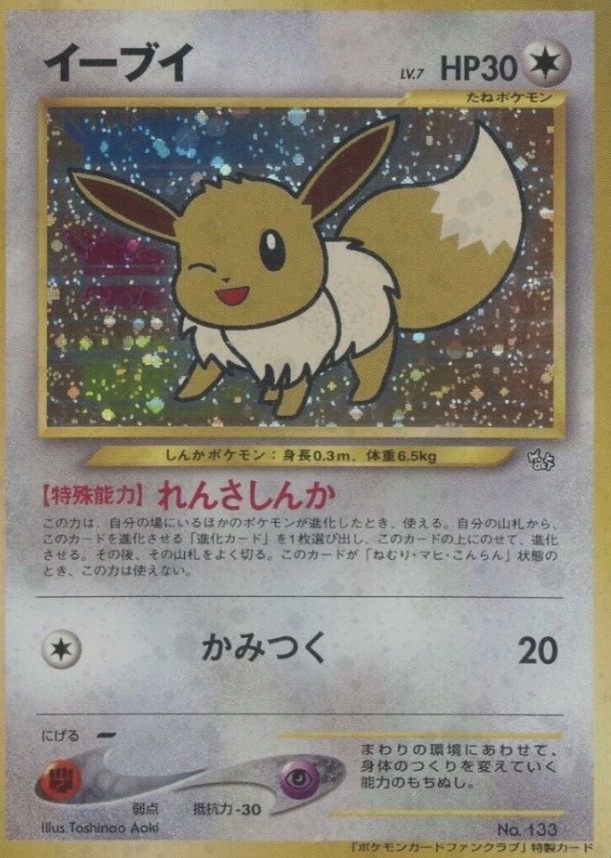
Unlike cards pulled from booster packs, this Eevee had to be earned.
Members of the Japanese Pokémon Card Fan Club could accumulate special GET Points through Pokémon Card Game activities. Once a member reached 500 GET Points, they could exchange those points for this exclusive holographic Eevee promo.
That alone makes the card historically interesting, but there is another fascinating part of its story.
The card’s Pokémon Power “Chain Reaction” and attack “Bite” were later used on other Eevee promos, including the American Wizards Black Star Promo #11 and an unusual English-language Eevee distributed in Japan through the JR East Pokémon Stamp Rally 2000.
Those three cards create one of the most interesting Eevee promo families from the early Pokémon TCG era.
What Is the Pokémon Card Fan Club Eevee?
The Fan Club Eevee is an unnumbered Japanese promotional card first distributed through the Pokémon Card Fan Club in 2000.
It was not available in booster packs or ordinary retail products.
Collectors had to participate in the Pokémon Card Fan Club’s GET Points program and accumulate 500 points before they could receive the card.
The promotion began in April 2000, and the card remained available through the Fan Club until the end of 2002.
This means obtaining the card originally required substantially more effort than simply purchasing a Pokémon product.
Pokémon Card Fan Club Eevee Card Information
| Pokémon | Eevee |
|---|---|
| Pokédex Number | No.133 |
| HP | 30 |
| Type | Colorless |
| Card Type | Basic Pokémon |
| Release | Pokémon Card Fan Club Promo |
| Year | 2000 |
| Requirement | 500 GET Points |
| Finish | Holofoil |
| Illustrator | Toshinao Aoki |
| Card Number | Unnumbered / No.133 Pokédex number |
| Language | Japanese |
What Were GET Points?
The Pokémon Card Fan Club used a reward system known as GET Points.
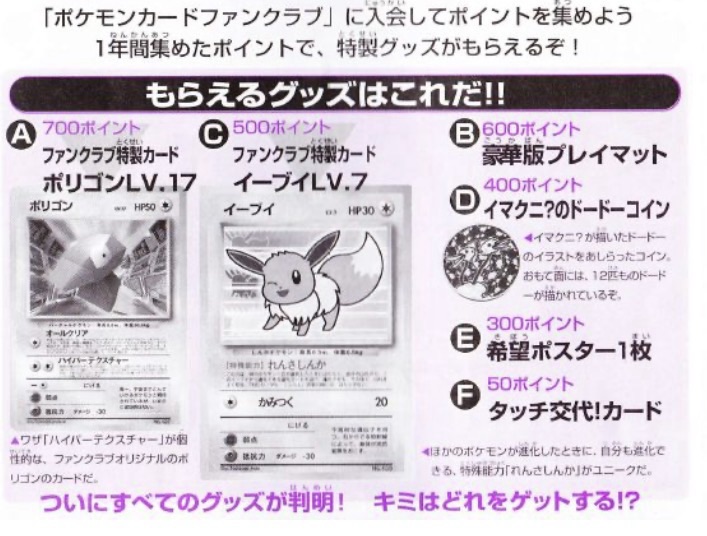
Rather than simply buying a product and receiving a promotional card, Fan Club members accumulated points through Pokémon Card Game-related participation and activities.
The points could then be exchanged for special rewards.
Among the most famous rewards were three highly collectible Pokémon cards:
| GET Points | Reward |
|---|---|
| 500 Points | Eevee |
| 600 Points | Shining Magikarp |
| 700 Points | Porygon |
Today these cards are often grouped together by collectors as the classic Pokémon Card Fan Club GET Point promos.
Interestingly, the Eevee was technically the lowest card reward of the three, requiring 500 points rather than 600 or 700.
That does not mean it is inexpensive today.
In fact, Eevee’s enormous popularity combined with the difficulty of finding pristine examples has turned the 500 Point Eevee into an extremely valuable collector card.
Affiliate Disclosure: As an eBay Partner Network affiliate, I may earn a commission from qualifying purchases at no additional cost to you.
The Exclusive Toshinao Aoki Artwork
One of the most important features of the 500 Point Eevee is its artwork.
The Japanese Fan Club version was illustrated by Toshinao Aoki.
Eevee appears in front of an elaborate stained-glass-style background featuring imagery connected with its three original evolutions:
- Vaporeon
- Jolteon
- Flareon
This makes the illustration particularly appropriate for Eevee.
More importantly, this artwork was not reused for the American version of the card.
When the same card mechanics were brought to the English Pokémon TCG, Eevee received completely different artwork.
The GET Logo
The Japanese Fan Club Eevee also has a small but important identifying feature.

Instead of a normal expansion symbol, the card displays the Pokémon Card Fan Club GET campaign logo.
The bottom of the card also identifies it as a special Pokémon Card Fan Club card.
These details immediately separate the Fan Club Eevee from ordinary Japanese set cards.
Chain Reaction — The Special Pokémon Power
The card’s most interesting gameplay feature is its Pokémon Power:
Chain Reaction — れんさしんか
The Power allows Eevee to evolve when another Pokémon evolves.
When the condition is met, the player can search the deck for a card that evolves from Eevee and place it onto Eevee, treating the action as evolution.
This perfectly matches Eevee’s identity as the Evolution Pokémon.
The card also has:
Bite — 20 damage
What makes this especially interesting for collectors is that the same basic card text did not remain exclusive to this expensive Japanese promo.
It soon appeared on another Eevee card on the other side of the Pacific.
The American Wizards Black Star Promo Eevee #11
In June 2000, an English Eevee using the same Pokémon Power and attack was distributed through the Pokémon League.
It became Wizards Black Star Promo #11.
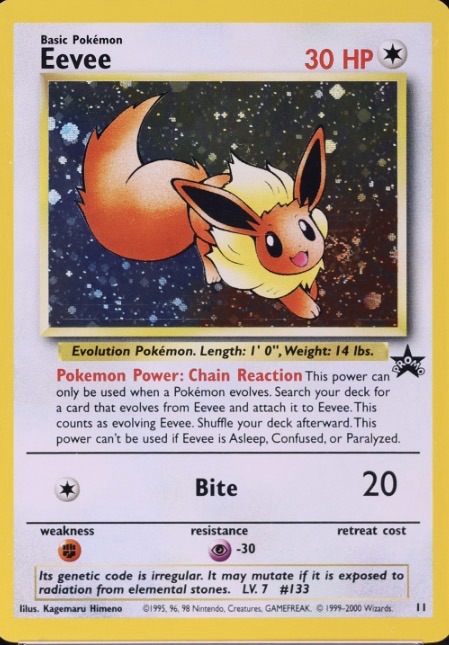
Wizards of the Coast produced 53 numbered Black Star promotional cards during its era of the Pokémon TCG, and Eevee #11 is one of the best-known early examples.
However, the English card does not simply translate the Japanese Fan Club card.
The biggest difference is the artwork.
| Feature | Japanese Fan Club Eevee | Wizards Black Star Eevee |
|---|---|---|
| Year | 2000 | 2000 |
| Language | Japanese | English |
| Distribution | 500 GET Points | Pokémon League |
| Illustrator | Toshinao Aoki | Kagemaru Himeno |
| Pokémon Power | Chain Reaction | Chain Reaction |
| Attack | Bite 20 | Bite 20 |
| HP | 30 | 30 |
| Finish | Holofoil | Holofoil |
So from a gameplay perspective, the cards are closely related.
From an artwork and collecting perspective, however, they are completely different.
The Kagemaru Himeno Eevee Artwork
The Wizards Black Star Promo uses artwork by Kagemaru Himeno.
Instead of the elaborate stained-glass composition of the Japanese Fan Club card, this Eevee has a completely different illustration.
This creates an interesting situation for Eevee collectors.
There are effectively two major artwork branches of this card:
Toshinao Aoki artwork → Japanese 500 Point Fan Club Eevee
Kagemaru Himeno artwork → English Wizards Black Star Promo and Japanese JR Stamp Rally release
And that second branch leads to an even stranger card.
The JR East Pokémon Stamp Rally Eevee
One of the most overlooked versions of this Eevee was distributed not in America, but in Japan.
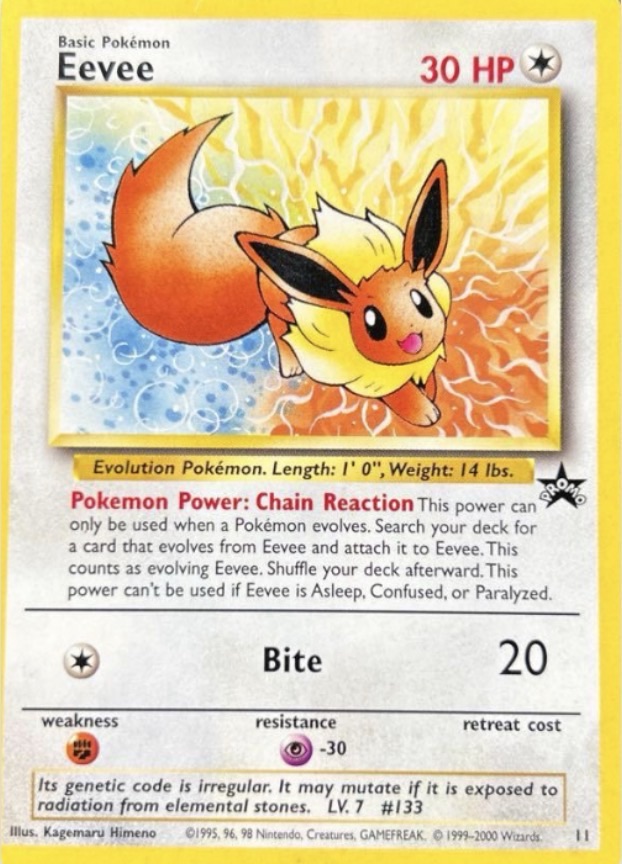
During the JR East Pokémon Stamp Rally 2000, participants traveled around the JR East railway network collecting Pokémon stamps.
The event ran during August 2000.
Participants who completed the Gold Course could receive an Eevee promotional card.
But instead of receiving the Japanese Fan Club Eevee, they received something much stranger:
An English-language version based on Wizards Black Star Promo Eevee #11.
That makes the JR Stamp Rally Eevee a fascinating crossover between Japanese and English Pokémon card history.
JR Stamp Rally Eevee vs. American Black Star Promo
At first glance, the two cards can look extremely similar.
Both feature:
- Eevee
- 30 HP
- English text
- Black Star Promo #11 design
- Kagemaru Himeno artwork
- Chain Reaction
- Bite for 20 damage
But there is one major difference collectors should know:
The standard American Wizards Black Star Promo Eevee is holofoil, while the JR East Stamp Rally version is non-holo.
| Version | Artwork | Language | Finish | Distribution |
|---|---|---|---|---|
| Fan Club 500 Point | Toshinao Aoki | Japanese | Holo | Pokémon Card Fan Club |
| Wizards Black Star #11 | Kagemaru Himeno | English | Holo | Pokémon League |
| JR East Stamp Rally | Kagemaru Himeno | English | Non-Holo | JR East Pokémon Stamp Rally 2000 |
This distinction is important because sellers sometimes list the JR Rally card simply as an unusual Black Star Promo.
For collectors attempting to build a complete Eevee collection—or even a complete Wizards Black Star Promo variant collection—the non-holo JR version is a card worth knowing.
An English Pokémon Card Released in Japan
The JR Stamp Rally version is particularly unusual because it challenges the normal way collectors classify Pokémon cards.
It has English card text and uses the Wizards Black Star Promo design, yet its distribution took place in Japan.
It therefore belongs to a small and fascinating group of English-language Pokémon cards connected specifically with Japanese promotional events.
For collectors who focus only on Japanese-language cards, this release can easily be overlooked.
For collectors studying Japanese distribution history, however, it absolutely belongs in the conversation.
Other JR Stamp Rally Black Star Promo Connections
Eevee was not the only English-style promotional card associated with Japanese railway stamp rallies around this period.
Other unusual releases include Black Star-style versions of Mewtwo and Meowth.
These releases are an excellent example of how complicated vintage Pokémon promo collecting can become.
A card’s language does not always tell you where it was distributed.
A Small Error on the English Eevee
The English Eevee #11 also contains a subtle detail that many collectors never notice.
In the heading for its Pokémon Power, “Pokemon Power” is printed without the accent over the “é”.
It is an extremely small typography detail, but exactly the kind of oddity that makes early Wizards-era promotional cards interesting to specialist collectors.
Why Is the 500 Point Fan Club Eevee So Expensive?
The Japanese Fan Club Eevee has become dramatically more valuable than the ordinary Wizards Black Star Promo.
There are several reasons:
- It could only be obtained by accumulating 500 GET Points.
- It was never available in booster packs.
- Its Toshinao Aoki artwork remained exclusive to the Japanese Fan Club release.
- It is a vintage Japanese holo promo.
- Eevee and the Eeveelutions have enormous collector demand.
- High-grade examples are exceptionally difficult to find.
- The GET Points distribution story has become increasingly appreciated by vintage collectors.
The last point is particularly important.
This card is not valuable simply because it is old.
It represents an era when some of the best Japanese promotional cards had to be earned through participation rather than purchased directly.
PSA Population
High-grade Fan Club Eevee cards are extremely scarce.
As of 2026, PSA’s certification database shows only around 82 PSA 10 examples of the 500 Point Fan Club Eevee.
That is dramatically different from many popular vintage Pokémon cards that have thousands—or even tens of thousands—of Gem Mint examples.
The combination of a small PSA 10 population and enormous global demand for Eevee has created an extraordinary high-end market.
The Incredible Rise of the PSA 10 Fan Club Eevee
The market for this card has changed dramatically.
PSA 10 examples that sold for around $6,000–$6,600 in 2024 moved into five-figure territory during 2025.
In March 2026, a PSA 10 example sold for approximately $43,200.
Then the market moved even higher.
A PSA 10 sold for approximately $84,000 in July 2026, followed by another public sale for an extraordinary $90,000 in August 2026.
| Date | PSA 10 Sale |
|---|---|
| September 2024 | ~$6,600 |
| October 2024 | ~$6,000 |
| June 2025 | ~$10,800 |
| March 2026 | ~$43,200 |
| July 2026 | ~$84,000 |
| August 2026 | ~$90,000 |
That progression makes the Fan Club Eevee one of the clearest examples of how dramatically demand for elite Japanese promotional cards has changed.
Because sales are infrequent, however, collectors should be careful about treating any single auction result as a permanent market value.
What About PSA 9 and Raw Copies?
The gap between grades can be enormous.
Recent PSA 9 sales have ranged from roughly $4,600 to well above $10,000, illustrating how volatile the market can be when only a small number of copies are available.
Raw copies are even more difficult to price because condition has such a large impact on value.
Current asking prices can also be significantly higher than completed sales.
When evaluating this card, collectors should compare actual completed transactions whenever possible rather than relying solely on active listings.
How Valuable Is the JR Stamp Rally Eevee?
The JR East Stamp Rally Eevee occupies a completely different market from the 500 Point Fan Club card.
It is considerably less expensive, but the non-holo Japanese-distributed variant can still command a substantial premium over an ordinary American Eevee #11.
Recent market data has placed raw JR Rally copies in the hundreds of dollars, with examples around $160–$170 appearing in completed sales during 2026 and some market estimates considerably higher.
PSA 10 examples have also produced sales ranging from several hundred dollars to approximately $800+.
By comparison, the ordinary American Wizards Black Star Promo #11 is much easier to obtain and generally trades for far less.
Three Eevee Cards, One Fascinating Family
Looking at these three cards together tells a much more interesting story than studying the Fan Club Eevee alone.
| Card | Where Released | Artwork | Finish | Key Feature |
|---|---|---|---|---|
| 500 Point Fan Club Eevee | Japan | Toshinao Aoki | Holo | 500 GET Point reward |
| Wizards Black Star Eevee #11 | United States / English market | Kagemaru Himeno | Holo | Pokémon League promo |
| JR East Stamp Rally Eevee #11 | Japan | Kagemaru Himeno | Non-Holo | English card distributed in Japan |
All three share the same fundamental gameplay concept:
Chain Reaction + Bite 20.
But their artwork, language, finish, distribution method, rarity, and current values are dramatically different.
Which Version Is the Most Collectible?
For high-end Japanese promo collectors, the 500 Point Fan Club Eevee is clearly the centerpiece.
Its exclusive artwork, GET Points history, holofoil treatment, and tiny high-grade population have made it one of the premier Eevee cards in the hobby.
However, the JR Stamp Rally Eevee may actually be the more surprising card for many collectors.
It looks like an American Wizards promo, is written in English, but was distributed through a Japanese railway event and differs from the normal Black Star Promo by being non-holo.
For an Eevee master set, owning all three tells the complete story much better than owning only the expensive Fan Club card.
Buying Tips
Collectors purchasing the Fan Club Eevee should pay close attention to condition.
Important areas include:
- Holofoil scratches
- Surface dents
- Print lines
- Edge whitening
- Corner wear
- Centering
- Holofoil clouding
With the enormous difference between PSA grades, even relatively small defects can represent thousands—or potentially tens of thousands—of dollars in market value.
For the JR Stamp Rally version, make sure the card is actually the non-holo Japanese-distributed variant rather than the much more common holo Wizards Black Star Promo.
Final Thoughts
The Pokémon Card Fan Club Eevee is much more than an expensive Eevee card.
It represents one of the most interesting reward systems from the early Japanese Pokémon TCG.
Collectors had to accumulate 500 GET Points to obtain the card, and its beautiful Toshinao Aoki artwork remained exclusive to that Japanese release.
Its card mechanics then crossed into the English TCG through Wizards Black Star Promo #11 with completely different Kagemaru Himeno artwork.
That English design then traveled back to Japan in perhaps the strangest chapter of the story: a non-holo English-language version distributed through the JR East Pokémon Stamp Rally 2000.
Japan → America → Japan.
Three releases, two artworks, two languages, two different holo treatments, and three completely different distribution methods—all connected by the same Eevee card concept.
For collectors interested in vintage Japanese Pokémon history rather than simply card prices, this is exactly the kind of promotional story that makes the early Pokémon TCG era so fascinating.
Related Guides
- JR Pokémon Stamp Rally 2000 Eevee
- JR Surfing Pikachu: Japanese Railway Promo Guide
- Trainer’s Porygon: Japanese Vintage Promo Guide
- Birthday Pikachu: Japanese Vintage Promo Guide
Looking for more vintage Pokémon card guides?
Visit the complete archive here: