▶ Browse All Vintage Japanese Pokémon Card Guides
Charmander Japanese Vending Series | Expansion Sheet Blue Version Price & PSA 10 Guide
Charmander from the Japanese Vending Series Expansion Sheet Blue Version is one of the most collectible vintage Japanese Charmander cards from the original Pokémon TCG era.
Released in 1998, this Charmander was part of the first Expansion Sheet set, commonly known among international collectors as the Japanese Vending Series.
Unlike the regular Base Set-era Japanese Charmander, this version was distributed through a Carddass-style vending machine system and features a distinctive surface finish and unique artwork by Atsuko Nishida.
The combination of an original Kanto starter Pokémon, vintage Japanese-exclusive distribution, and distinctive artwork has made this card increasingly popular among international collectors.
As of 2026, a Near Mint copy is around ¥14,000, while a PSA 10 example is valued at approximately ¥47,000 based on the market data tracked for this article.
In this guide, we will look at the card’s history, the Expansion Sheet Blue Version, how it differs from the regular Base Set Charmander, current prices, PSA 10 values, and what to check before buying.
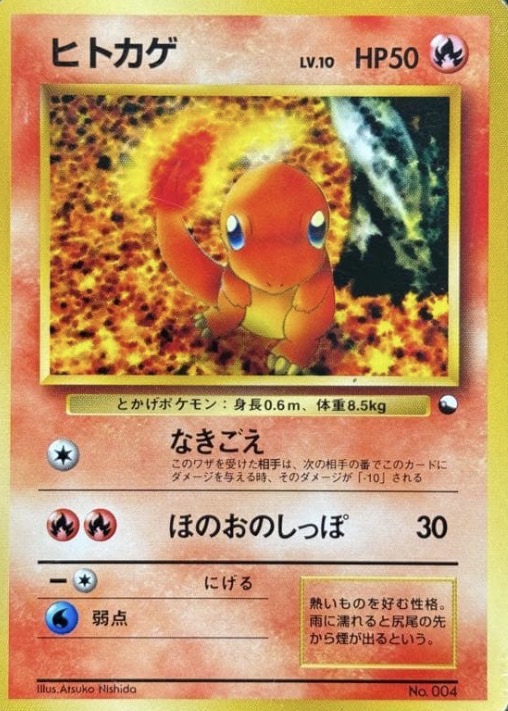
Card Information
- Card: Charmander
- Japanese Name: ヒトカゲ
- Level: Lv.10
- HP: 50
- Type: Fire
- Rarity: ◆ Diamond / Uncommon
- Card Number: No. 013
- Set: Expansion Sheet Series 1 – Blue Version
- Release Date: March 23, 1998
- Illustrator: Atsuko Nishida
- International Collector Name: Japanese Vending Series
What Is the Japanese Vending Series Charmander?
This Charmander was released in 1998 as part of the first Japanese Expansion Sheet series.
The Expansion Sheet cards were not sold through conventional booster packs. Instead, they were distributed through a special Carddass-style vending machine system.
The Blue Version of the first Expansion Sheet series was released on March 23, 1998, with cards available through the vending machines for 100 yen per purchase.
For international collectors, these cards are now commonly referred to as the Japanese Vending Series.
The Vending Series has developed into its own collecting category, separate from the regular Japanese Base Set and other early expansion sets.
Charmander is particularly attractive within this category because it combines one of the most recognizable Pokémon with artwork that is unique to this release.
Atsuko Nishida’s Charmander Artwork
One of the biggest reasons collectors seek this card is its artwork by Atsuko Nishida.
The Charmander has a softer, watercolor-like appearance that is very different from the regular Japanese Base Set Charmander.
This gives the card a distinctive vintage Japanese aesthetic that is difficult to reproduce in modern Pokémon cards.
For collectors who focus on Pokémon artwork, this is an important distinction.
The card is not valuable simply because it features Charmander. The specific artwork, printing, and original distribution method are major parts of its appeal.
How Is It Different From the Regular Japanese Charmander?
There are multiple vintage Japanese Charmander cards, so identifying the exact version is important.
The most common comparison is between the Expansion Sheet Blue Version and the regular Japanese Base Set Charmander.
| Feature | Expansion Sheet Blue | Japanese Base Set |
|---|---|---|
| Product | Expansion Sheet Series 1 – Blue | Japanese Base Set |
| Distribution | Carddass-style vending machine | Booster pack |
| Level | Lv.10 | Lv.10 |
| HP | 50 | 50 |
| Rarity | ◆ Diamond | ● Circle |
| Illustrator | Atsuko Nishida | Mitsuhiro Arita |
| Surface | Distinctive Vending finish | Standard card finish |
As you can see, these are not simply two copies of the same card.
The product, distribution method, rarity symbol, artwork, and surface characteristics are different.
When searching for the Vending Series version, keywords such as “Charmander Japanese Vending,” “Charmander Expansion Sheet,” “Blue Version,” and “No. 013” can help avoid buying the wrong printing.
What Is the Expansion Sheet Series 1 Blue Version?
The Expansion Sheet Series 1 Blue Version was released in Japan on March 23, 1998.
It was one of the unusual products from the early Pokémon TCG era and was sold through vending machines rather than conventional booster packs.
The set included many Pokémon that remain highly collectible today, including:
- Bulbasaur
- Charmander
- Squirtle
- Pikachu
- Mewtwo
- Chansey
- Snorlax
The original starter Pokémon are especially popular because they combine the nostalgia of the first generation with the distinctive artwork of the Vending Series.
There is also another collecting angle to these cards.
Some collectors pursue individual cards, while others collect the original unpeeled vending sheets.
As a result, the Japanese Vending Series appeals to both individual-card collectors and sealed vintage collectors.
Current Charmander Price Guide
The value of this Charmander is considerably higher than that of many ordinary vintage Charmander cards.
| Condition | Reference Value |
|---|---|
| Near Mint | ≈ $90 |
| PSA 9 | $120 |
| PSA 10 | ≈ $320 |
Based on the market research tracked for this article, the current reference figures are approximately $90 for a raw copy and $329 for PSA 10.
These figures should be treated as market references rather than guaranteed sale prices. Vintage Pokémon card prices can change significantly depending on condition, timing, marketplace, and availability.
Interestingly, international market activity can sometimes produce prices that are considerably higher than Japanese domestic references.
Some PSA 10 examples have traded above $1,000 in the international market, demonstrating how differently Japanese Vending Series cards can be valued by overseas collectors.
For that reason, collectors should compare both Japanese and international listings before deciding what represents a fair price.
Why Is This Charmander So Popular?
The popularity of this card comes from several different collecting factors coming together.
- Charmander is one of the original Kanto starter Pokémon.
- The artwork is exclusive to this vintage Japanese release.
- Atsuko Nishida is one of the most important Pokémon illustrators.
- The card comes from the 1998 Japanese Vending Series.
- International collectors actively pursue Japanese Vending cards.
- The ◆ rarity symbol distinguishes it from the regular Base Set version.
- High-grade examples are much harder to find after nearly three decades.
The combination is particularly strong because Charmander is already one of the most recognizable Pokémon in the hobby.
When that popularity is combined with a rare vintage Japanese printing, demand becomes much stronger than it would be for an ordinary Charmander card.
eBay Market for Japanese Vending Charmander
eBay is one of the best places for international collectors to search for this card.
Japanese Vending Series cards are well known among overseas collectors, and eBay listings can include both raw and professionally graded examples.
Useful search terms include:
- Japanese Vending Charmander
- Charmander Expansion Sheet Blue
- Charmander Vending Series
- Japanese Charmander No. 013
- Charmander Vending PSA 10
Affiliate Disclosure: As an eBay Partner Network affiliate, I may earn a commission from qualifying purchases at no additional cost to you.
Checking eBay Listings
When shopping on eBay, be careful with generic titles such as “Japanese Charmander”.
There are many different Japanese Charmander cards from the vintage era, and a seller may not always include the term “Vending Series” in the title.
Look closely at the card image and confirm the artwork, rarity symbol, surface, and No. 013 identification before purchasing.
PSA-graded copies can be particularly useful because the exact card version is normally identified on the certification label.
Check eBay Sold Prices
For a vintage card like this, sold listings are generally more useful than active asking prices.
A seller can list a PSA 10 for an extremely high price, but that does not necessarily mean collectors are actually paying that amount.
When researching the market, compare completed sales for the same version and similar grade.
This is particularly important for Japanese Vending cards because transaction volume can be relatively low compared with modern Pokémon cards.
Buying Tips
If you are looking for this specific Charmander, the most important thing is to identify the correct printing.
Before buying, check the following:
- Confirm that the Pokémon is Charmander.
- Confirm Lv.10 and HP50.
- Check for the ◆ Diamond rarity symbol.
- Confirm the card is from the Expansion Sheet Series 1 Blue Version.
- Look for the distinctive Vending Series surface finish.
- Confirm the artwork by Atsuko Nishida.
- Check the four corners for whitening.
- Inspect the edges carefully.
- Check the front surface for scratches.
- Inspect the back for whitening and damage.
- For PSA cards, verify the card number and certification information.
Because these cards are almost 30 years old, condition is extremely important.
Small scratches can be difficult to see in normal photographs, particularly with the distinctive surface of Vending Series cards.
If you are considering a high-value copy, request or inspect detailed photographs of both the front and back whenever possible.
PSA 10: What Should Collectors Look For?
PSA 10 examples of vintage Japanese cards are difficult to find because the cards have spent decades in different storage environments.
For this Charmander, the most important areas to inspect include:
- Holo or surface scratches
- Corner whitening
- Edge whitening
- Centering
- Print quality
- Back-side condition
The special surface of the Expansion Sheet cards can make small imperfections more noticeable under direct light.
A card that looks excellent under normal lighting may reveal scratches when photographed or examined at an angle.
For collectors buying raw copies with the intention of grading them, this is particularly important.
Charmander Collection: Build the Kanto Starter Trio
One of the most satisfying ways to collect the Expansion Sheet Blue Version is to build the original starter trio.
Bulbasaur
×
Charmander
×
Squirtle
Collecting all three in the same Vending Series style creates a very different look from the regular Japanese Base Set starter trio.
Collectors can also go further and build complete evolution lines:
Charmander → Charmeleon → Charizard
Having the entire evolution line in the same Japanese Vending Series style is a much more advanced collecting goal and can become significantly more expensive, especially in high grades.
Charmander and the International Market
The Japanese Vending Series has become increasingly recognizable outside Japan.
International collectors often search specifically for Japanese Vending cards rather than simply looking for old Japanese Pokémon cards.
This distinction matters because Vending Series cards have their own artwork, distribution history, and collecting culture.
Charmander benefits from that recognition while also having one of the strongest Pokémon names in the hobby.
For collectors who primarily own English cards, adding a Japanese Vending Charmander can also introduce an entirely different side of vintage Pokémon collecting.
Is This Charmander a Good Long-Term Collectible?
Predicting future prices for vintage Pokémon cards is impossible, but several characteristics make this Charmander appealing from a collector’s perspective.
- 1998 vintage release
- Original Kanto starter Pokémon
- Japanese-exclusive Vending Series distribution
- Distinctive Atsuko Nishida artwork
- Strong international collector recognition
- Limited availability in high condition
Rather than relying solely on price appreciation, the stronger argument for this card is its historical and collecting significance.
It represents a very specific period of Japanese Pokémon TCG history that cannot be recreated today.
Frequently Asked Questions
What is the Japanese Vending Series?
The Japanese Vending Series refers to early Pokémon cards distributed through vending machines in Japan. The cards are now highly collectible internationally because of their unique artwork and distribution history.
When was this Charmander released?
The Expansion Sheet Series 1 Blue Version was released on March 23, 1998.
What Level is this Charmander?
This Charmander is Lv.10 with 50 HP.
Who illustrated this Charmander?
The artwork was created by Atsuko Nishida, one of the most influential artists in Pokémon TCG history.
How is it different from the Japanese Base Set Charmander?
The Expansion Sheet version has different artwork, a different rarity symbol, and a distinctive Vending Series surface. It was also distributed through vending machines rather than standard booster packs.
How much is the Charmander worth?
A current reference price for a Near Mint raw copy is approximately $90, while a PSA 10 reference is approximately $320. Actual prices can vary significantly.
Can the PSA 10 price be higher overseas?
Yes. International sales can sometimes be significantly higher than domestic Japanese market references. Some PSA 10 examples have exceeded $1,000, although individual transactions should always be checked before establishing a market value.
Where can I buy this Charmander?
eBay is one of the most convenient marketplaces for international collectors. Search using terms such as “Japanese Vending Charmander” or “Charmander Expansion Sheet Blue.”
Is this the same artwork as the regular Japanese Charmander?
No. The Expansion Sheet version features artwork by Atsuko Nishida that is different from the regular Japanese Base Set Charmander.
Related Guides
- Top 20 Most Valuable Japanese Vending Series Cards
- Mewtwo Japanese Vending vs. Quick Starter Guide
- Quick Starter Gift: Valuable Cards & Sealed Product Guide
Final Thoughts
The Japanese Vending Series Charmander is one of the most appealing vintage Japanese versions of the original Fire-type starter.
Released in 1998 as part of the Expansion Sheet Series 1 Blue Version, it represents a completely different side of early Japanese Pokémon collecting compared with standard booster-pack cards.
The unique vending-machine distribution, distinctive surface, ◆ rarity symbol, and Atsuko Nishida artwork all contribute to its collector appeal.
Its value is also supported by the popularity of Charmander itself and the growing international interest in Japanese Vending Series cards.
For collectors, the most important thing is to identify the correct printing. The regular Japanese Base Set Charmander and the Expansion Sheet version may look similar in listings, but they are different collectibles.
At around $90 for a Near Mint raw copy and approximately $320 for PSA 10 based on the current reference data, this is already a meaningful collectible within the vintage Japanese Pokémon market.
Whether you are collecting the original Kanto starters, Japanese Vending Series cards, Atsuko Nishida artwork, or simply looking for an unusual 1998 Pokémon card, this Charmander is a card worth adding to your radar.
More Vintage Japanese Pokémon Card Guides
Explore more rare Japanese promotional cards, Vending Series releases, vintage Pokémon cards, and collector-focused price guides.
▶ Browse All Vintage Japanese Pokémon Card Guides
Original article published: August 31, 2026