Mewtwo δ 107/PCG-P is one of the most interesting Japanese Mewtwo cards from the EX-era Pokémon TCG.
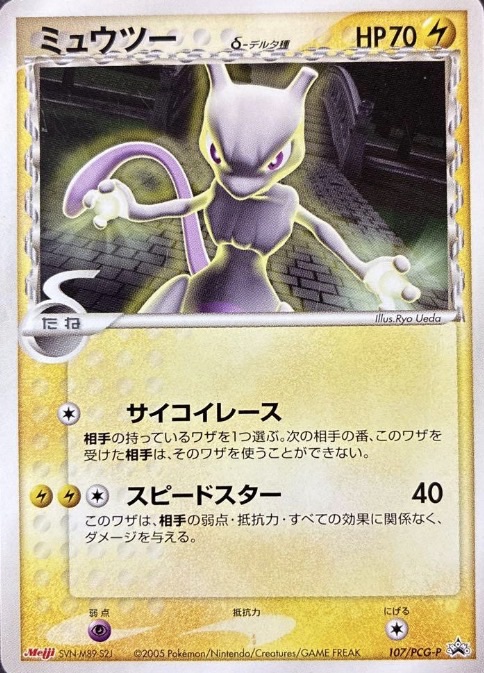
Released in Japan on October 17, 2005, this Mewtwo was distributed as an exclusive bonus card with Meiji Seika’s Pokémon Chocolate Snack.
The card is numbered 107/PCG-P and features Mewtwo as a δ-Delta Species Pokémon.
What makes this card particularly interesting is that Mewtwo is normally associated with the Psychic type, yet this particular version is a Lightning-type Mewtwo with 70 HP.
The artwork by Ryo Ueda shows Mewtwo standing in a dark urban environment, with its long tail and psychic energy prominently displayed.
There is also a small but important detail on the bottom of the card: the Meiji logo.
This is not a normal expansion-set Mewtwo. It was originally distributed as a Japanese promotional card through a food-product collaboration, making it a great example of the unusual ways Pokémon cards were distributed in Japan during the 2000s.
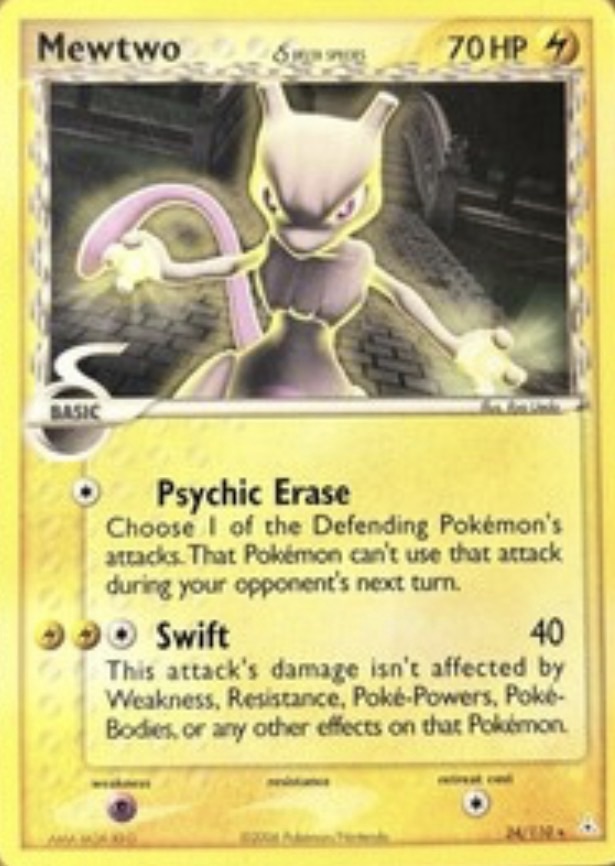
Even more interestingly, this Japanese promo later became the source for the English Mewtwo δ 24/110 from EX Holon Phantoms.
For collectors of Mewtwo, Delta Species, Japanese-exclusive promos, or obscure Meiji Pokémon releases, 107/PCG-P is a card worth knowing.
Mewtwo δ 107/PCG-P Card Information
- Card Name: Mewtwo δ
- Japanese Name: ミュウツー δ-デルタ種
- Card Number: 107/PCG-P
- Release Date: October 17, 2005
- Series: PCG-P Promotional Cards
- Promotion: Meiji Seika Pokémon Chocolate Snack Vol. 4
- Type: Lightning
- HP: 70
- Stage: Basic Pokémon
- Pokémon: Mewtwo
- Pokédex Number: #150
- Illustrator: Ryo Ueda
- Rarity: Promo
- Weakness: Psychic ×2
- Resistance: None
- Retreat Cost: 1
- English Equivalent: Mewtwo δ 24/110, EX Holon Phantoms
What Is Mewtwo 107/PCG-P?
Mewtwo 107/PCG-P is a Japanese promotional card featuring Mewtwo as a Delta Species Pokémon.
The card belongs to the large PCG-P promotional-card series used during the Pokémon Card Game’s EX era.
However, the card itself was not distributed at a Pokémon tournament or through a traditional Pokémon TCG product.
Instead, it came from a collaboration between Pokémon and Meiji Seika.
Specifically, it was one of the promotional cards included with Pokémon Chocolate Snack Vol. 4.
This makes it part of a fascinating category of Japanese Pokémon cards that were obtained by purchasing food products rather than booster packs.
The card itself is a standard-size Pokémon TCG card, but its distribution history is very different from cards found in conventional expansions.
The Meiji Chocolate Snack Promotion
The Mewtwo was released as part of the fourth series of Meiji’s Pokémon Chocolate Snack promotion.
The fourth series was released in Japan in October 2005.
Each Pokémon Chocolate Snack included one Pokémon card, and the card inside was not known until the package was opened.
The official promotional information described the fourth series as featuring original Pokémon Card Game cards, including Pokémon with the newly emphasized δ-Delta Species designation.
The packaging also contained one of several sections explaining how to play the Pokémon Card Game.
The different sections were designed so that collectors could gather them all and assemble a more complete set of gameplay instructions.
This means the product was more than simply a chocolate snack with a random card.
It was part of a broader Pokémon collecting promotion.
The 12-Card Meiji Pokémon Chocolate Snack Set
Mewtwo 107/PCG-P was one of 12 cards associated with the October 2005 Meiji Chocolate Snack release.
The sequence runs from 101/PCG-P through 112/PCG-P.
The cards were:
- 101/PCG-P: Forretress
- 102/PCG-P: Flareon
- 103/PCG-P: Rayquaza δ
- 104/PCG-P: Vaporeon
- 105/PCG-P: Corphish
- 106/PCG-P: Jolteon
- 107/PCG-P: Mewtwo δ
- 108/PCG-P: Ditto
- 109/PCG-P: Donphan
- 110/PCG-P: Marshtomp
- 111/PCG-P: Eevee
- 112/PCG-P: Pikachu δ
The set is particularly interesting because it mixes ordinary Pokémon with several Delta Species cards.
Mewtwo and Pikachu are two of the most recognizable names in the group, while Rayquaza is another particularly notable Delta Species Pokémon.
For collectors attempting to complete the entire Meiji Chocolate Snack Vol. 4 run, Mewtwo 107/PCG-P is therefore one piece of a 12-card promotional series.
Why Is Mewtwo a Lightning-Type Pokémon?
This is probably the first thing that catches the attention of collectors who see the card for the first time.
Mewtwo is a Psychic Pokémon, so why is this card Lightning-type?
The answer is the Delta Species concept.
During the EX era, Pokémon with the δ designation could have types that were different from their normal Pokémon type.
Mewtwo δ is one of the clearest examples.
Instead of appearing as a Psychic-type Pokémon, this Mewtwo is printed as a Lightning-type Pokémon.
The Lightning symbol appears in the upper-right portion of the card next to its 70 HP.
This unusual type is not an error or printing mistake.
It is an intentional characteristic of the Delta Species mechanic.
What Does δ-Delta Species Mean?
Delta Species was one of the defining concepts of the mid-2000s Pokémon TCG.
The idea was that certain Pokémon had been affected by unusual environmental conditions around the Holon region.
As a result, their Pokémon TCG types could differ from their conventional types.
Mewtwo δ is a particularly memorable example because the normally Psychic Mewtwo becomes a Lightning-type Pokémon.
The δ symbol printed next to Mewtwo’s name identifies it as a Delta Species Pokémon.
This also explains why the card is connected to the English EX Holon Phantoms expansion.
The Japanese promotional card effectively became one of the Japanese origins for the English Delta Species card pool.
The Artwork by Ryo Ueda
The artwork was created by Ryo Ueda.
Mewtwo is shown standing in what appears to be a dark industrial or urban environment.
The perspective is especially striking.
Rather than presenting Mewtwo in a simple portrait, the illustration places the viewer close to the Pokémon as it extends its arm and generates psychic energy.
The dark background contrasts strongly with Mewtwo’s pale purple body.
Its red eyes also stand out against the darker surroundings.
This gives the card a considerably more serious atmosphere than many of the playful Pokémon Chocolate Snack promos.
Ryo Ueda’s artwork is one of the reasons the card works particularly well as a standalone Mewtwo collectible.
A Closer Look at the Card Design
There are several small details that make this promo easy to identify.
At the top is the Japanese name:
ミュウツー δ-デルタ種
The upper-right corner shows:
HP 70
along with the Lightning-type symbol.
The illustration window occupies most of the upper half of the card.
Below the artwork are Mewtwo’s two attacks:
- Psychic Erase
- Swift — 40
At the bottom-right is the identifying card number:
107/PCG-P
The Meiji branding can also be seen near the bottom of the card.
That small logo is one of the easiest visual clues that this card came from the Meiji promotion.
Psychic Erase
The first attack is Psychic Erase.
It requires only one Colorless Energy.
Its effect allows the player to choose one of the Defending Pokémon’s attacks.
That attack then cannot be used during the opponent’s next turn.
This is an unusual form of disruption for such a low-energy attack.
Rather than focusing purely on damage, Psychic Erase interferes with what the opponent can do on their following turn.
Swift
Mewtwo’s second attack is Swift.
It requires:
- Lightning Energy
- Lightning Energy
- Colorless Energy
and deals 40 damage.
The important part of the attack is its effect.
Swift’s damage is not affected by:
- Weakness
- Resistance
- Poké-Powers
- Poké-Bodies
- Other effects on the Defending Pokémon
This makes Swift a classic example of the kind of unusual attack text found throughout the EX-era Pokémon TCG.
Mewtwo 107/PCG-P and EX Holon Phantoms
One of the most important facts about this card is its relationship with the English Pokémon TCG.
Mewtwo 107/PCG-P later appeared in English as:
Mewtwo δ — EX Holon Phantoms 24/110.
The English card retains the same basic concept, artwork, attacks, HP, and Delta Species identity.
This makes 107/PCG-P particularly interesting to international collectors.
It is not merely a Japanese card with no international connection.
It is the Japanese promotional counterpart associated with a card that English-speaking collectors may recognize from EX Holon Phantoms.
The Japanese version, however, has its own collecting appeal because of its original Meiji Chocolate Snack distribution and PCG-P numbering.
Japanese Promo vs. English Expansion Card
The relationship between the two versions is easy to misunderstand.
The Japanese card is:
Mewtwo δ 107/PCG-P
while the English card is:
Mewtwo δ 24/110 from EX Holon Phantoms.
Affiliate Disclosure: As an eBay Partner Network affiliate, I may earn a commission from qualifying purchases at no additional cost to you.
The Japanese card was a promotional release.
The English version was incorporated into a regular expansion.
This is an important distinction for collectors building a Japanese PCG-era collection.
The Japanese 107/PCG-P copy should not be treated as simply another language version of the English expansion card.
Its Meiji Chocolate Snack provenance gives it a separate collecting history.
Why the Meiji Connection Makes This Card Interesting
Meiji and Pokémon had a long history of combining food products with Pokémon collectibles.
For collectors today, this creates a fascinating problem.
The cards were originally obtained as accessories or bonuses with a consumer product.
In 2005, the primary reason for buying the snack was obviously not necessarily to preserve a Pokémon card for twenty years.
Many cards were opened, handled, stored casually, or separated from their original packaging.
That creates a natural attrition effect over time.
The original food product disappeared long ago, while surviving cards became collectible objects.
This is one reason food-distributed Pokémon cards can become surprisingly interesting decades later.
What Makes 107/PCG-P Different From a Normal Promo?
The word “promo” can make this card sound similar to modern promotional releases.
The historical context is very different.
This card was part of the PCG-P promotional numbering system used during the EX era.
Its distribution was tied to a commercial food promotion rather than a conventional Pokémon Center giveaway or tournament.
It therefore sits at the intersection of:
- Pokémon TCG
- Japanese promotional cards
- Meiji food merchandise
- Delta Species
- Mewtwo collecting
That combination is what makes 107/PCG-P particularly appealing to advanced collectors.
Mewtwo 107/PCG-P Price Guide
The market for this card has changed dramatically in recent years.
For a long time, 107/PCG-P was a relatively inexpensive Japanese promo compared with major vintage Mewtwo cards.
Recent sales, however, show a much stronger premium for high-grade examples.
As of late August 2026, public sales data shows a wide range between raw copies and PSA-graded cards.
Recent raw sales have generally appeared around the $25–$80 range, although condition and seller terms can produce significantly different results.
There have also been occasional higher-priced raw transactions.
The graded market is considerably more expensive.
| Condition | Recent Market Reference |
|---|---|
| Raw | Approximately $25–$80+ |
| PSA 7 | About $130 |
| PSA 8 | About $300 |
| PSA 9 | About $300–$330 |
| PSA 10 | About $3,500–$4,600+ in recent sales |
The most striking number is the PSA 10 market.
Recent public sales include PSA 10 examples at approximately $3,300, $3,500, $4,000, $4,550, $4,650, and $4,525, depending on the transaction and date.
One recent August 2026 sale reached $4,525.
This is a dramatic premium over raw examples.
However, collectors should be careful when interpreting these figures.
This is a relatively low-liquidity card, and a small number of sales can cause the apparent market price to move sharply.
Market Note: Prices are based on publicly recorded sales and market observations and can change significantly with condition, grading company, timing, availability, exchange rates, and buyer demand. Asking prices are not the same as completed sale prices.
Affiliate Disclosure: As an eBay Partner Network affiliate, I may earn a commission from qualifying purchases at no additional cost to you.
Why Has the PSA 10 Price Increased So Much?
The difference between raw and PSA 10 prices is one of the most interesting aspects of this card’s current market.
There are several possible reasons.
First, Mewtwo is one of the most collected Pokémon in the hobby.
Second, Delta Species cards have developed a dedicated collector base because the unusual Pokémon types and EX-era design are difficult to reproduce in later eras.
Third, this particular card has a recognizable Japanese-exclusive distribution story.
And fourth, the number of high-grade copies is much smaller than the number of raw cards that can be found.
According to current population data, PSA has graded approximately 297 copies of this card, including approximately 84 PSA 10s.
That means PSA 10 examples represent a relatively small portion of the total graded population.
This is not an ultra-low population card in the same sense as some extremely obscure Japanese promos.
But it is scarce enough that demand for Gem Mint copies can produce a very large price premium.
PSA Population
Current population data gives an interesting picture of the card’s grading distribution.
Reported PSA populations are approximately:
| Grade | Approx. PSA Population |
|---|---|
| PSA 1 | 2 |
| PSA 2 | 1 |
| PSA 3 | 2 |
| PSA 4 | 10 |
| PSA 5 | 14 |
| PSA 6 | 18 |
| PSA 7 | 23 |
| PSA 8 | 56 |
| PSA 9 | 87 |
| PSA 10 | 84 |
Population reports change as additional cards are graded, so collectors should always check the current report when evaluating rarity.
One particularly interesting feature is that there are substantially more PSA 9 copies than PSA 10 copies.
That gap is important when considering why Gem Mint examples command such a large premium.
Recent PSA 10 Sales
The recent PSA 10 market provides a much clearer picture of the card’s current demand.
Publicly recorded sales include:
- October 16, 2025: approximately $690
- April 1, 2026: approximately $3,500
- April 17, 2026: approximately $4,000
- July 23, 2026: approximately $4,650
- August 1, 2026: approximately $4,550
- August 24, 2026: approximately $4,525
The jump from the $690 October 2025 sale to the $4,000+ sales recorded in 2026 is particularly striking.
However, it should not be assumed that every PSA 10 is automatically worth $4,500.
The market is relatively illiquid, and sales can be affected by the exact buyer, seller, listing format, timing, and market conditions.
Still, the recent transactions clearly show that this once-obscure Japanese Meiji promo has attracted considerably more attention from high-grade collectors.
Raw Mewtwo vs. PSA 10
The gap between raw and PSA 10 is unusually large.
A raw copy can sometimes be found for only a few dozen dollars.
A PSA 10, meanwhile, has recently sold for more than $4,500.
That is why condition is so important with this card.
A raw copy that looks excellent may be worth examining carefully before automatically selling it cheaply.
At the same time, collectors should not assume that every raw copy is a potential PSA 10.
Centering, surface quality, corners, edges, print quality, and hidden dents can all affect the final grade.
Where to Buy Mewtwo 107/PCG-P
eBay is one of the easiest international marketplaces to monitor for this Japanese promo.
Because the card is relatively obscure outside Japan, sellers may use several different descriptions.
Try searching:
- Mewtwo 107/PCG-P
- Mewtwo Delta Species 107 PCG-P
- Mewtwo Meiji Chocolate 2005
- Japanese Mewtwo Delta Species Promo
- Mewtwo Meiji Promo
- ミュウツー 107/PCG-P
- ミュウツーδ デルタ種 明治
Searching by the Japanese card number is particularly useful because 107/PCG-P is much more specific than simply searching for “Japanese Mewtwo.”
How to Identify the Correct Mewtwo
There are many Japanese Mewtwo cards, so identification is important.
The easiest way to confirm 107/PCG-P is to check several features together.
Look for:
- ミュウツー at the top
- The δ-デルタ種 designation
- HP 70
- Lightning-type symbol
- Ryo Ueda artwork
- Psychic Erase
- Swift 40
- Meiji logo near the bottom
- 107/PCG-P at the bottom-right
- 2005 Pokémon copyright information
The card number is the most reliable identifier.
If a listing simply says “Japanese Mewtwo Promo,” ask for a photograph of the bottom-right corner.
What to Look for When Buying a Raw Copy
Because high-grade examples have become expensive, collectors should pay close attention to raw condition.
Check the following areas:
- Centering: Compare the left and right borders as well as the top and bottom.
- Surface: Look carefully for scratches, dents, and pressure marks.
- Corners: Check for whitening and soft corners.
- Edges: Inspect all four edges for whitening or chipping.
- Holo: This card is non-holo, so do not mistake the printed background texture for holographic foil.
- Print quality: Look for factory print defects and registration issues.
- Reverse: Always inspect the back as carefully as the front.
For an expensive raw copy, photographs taken under strong, angled lighting can reveal defects that are difficult to see in ordinary listing photographs.
Why This Mewtwo Is Not Holographic
Collectors sometimes expect an expensive vintage Mewtwo to be holographic.
107/PCG-P is different.
The card is a non-holo promotional card.
The yellow-gold background beneath the attack area can create some visual texture, but it is not traditional holographic foil.
This is important when comparing it with other Mewtwo cards from the same general era.
The value of 107/PCG-P comes primarily from its:
- Meiji Chocolate distribution
- Japanese PCG-P status
- Delta Species designation
- Mewtwo popularity
- Ryo Ueda artwork
- Limited high-grade population
rather than from holographic treatment.
Why Collectors Like Delta Species Mewtwo
Mewtwo is already one of the most recognizable Pokémon in the hobby.
The Delta Species mechanic adds another layer of collectibility.
Collectors can build an entire Mewtwo collection around different versions, eras, artists, and types.
This particular card offers something that many Mewtwo cards do not:
a Lightning-type Mewtwo.
That makes it instantly recognizable within a Mewtwo collection.
The card also comes from the EX-era Delta Species period, which has developed a strong following among collectors who appreciate the design and mechanics of mid-2000s Pokémon TCG.
Meiji Chocolate Promos Are Their Own Collecting Category
Mewtwo 107/PCG-P is also part of a much larger story.
Meiji produced multiple Pokémon Chocolate Snack promotions during the EX era.
These promotions created cards that can be difficult to categorize if you are only familiar with the major Pokémon TCG expansions.
The cards are officially part of the Japanese promotional-card numbering system, but their distribution was through consumer food products.
That makes Meiji promos particularly interesting for collectors who want to go beyond the conventional Japanese set checklist.
The October 2005 series is especially notable because it includes both familiar Pokémon and Delta Species cards.
What Makes the 2005 Release Historically Interesting?
By 2005, the Pokémon TCG had moved well beyond the original Base Set era.
The EX era was experimenting heavily with new concepts.
Delta Species was one of those concepts.
At the same time, Japanese Pokémon merchandise continued to appear in unconventional places.
The Meiji Chocolate Snack promotion brought these two trends together.
Mewtwo 107/PCG-P therefore captures an interesting moment in Pokémon TCG history:
the popularity of Mewtwo + the Delta Species era + Japanese food-product promotions.
That combination is difficult to reproduce in later Pokémon releases.
Frequently Asked Questions
What is Mewtwo 107/PCG-P?
Mewtwo 107/PCG-P is a Japanese promotional Mewtwo card released in 2005 as part of the Meiji Seika Pokémon Chocolate Snack Vol. 4 promotion.
When was Mewtwo 107/PCG-P released?
The card was released in Japan on October 17, 2005.
What is Mewtwo’s type on this card?
This Mewtwo is a Lightning-type Pokémon because it is a Delta Species Pokémon.
How much HP does Mewtwo 107/PCG-P have?
It has 70 HP.
Who illustrated Mewtwo 107/PCG-P?
The card was illustrated by Ryo Ueda.
What is the card number?
The Japanese promo number is 107/PCG-P.
What attacks does Mewtwo 107/PCG-P have?
It has Psychic Erase and Swift. Swift does 40 damage and its damage is unaffected by Weakness, Resistance, Poké-Powers, Poké-Bodies, or other effects on the Defending Pokémon.
Was Mewtwo 107/PCG-P included in a booster pack?
No. It was distributed with Meiji Seika Pokémon Chocolate Snack rather than a conventional Pokémon TCG booster pack.
How many cards were in the Meiji Chocolate Snack Vol. 4 series?
The October 2005 promotion is associated with 12 promotional cards numbered 101/PCG-P through 112/PCG-P.
Is Mewtwo 107/PCG-P the same as the English Mewtwo from EX Holon Phantoms?
It is the Japanese promotional counterpart of Mewtwo δ 24/110 from EX Holon Phantoms, sharing the same Delta Species concept, artwork, HP, and attacks.
Is Mewtwo 107/PCG-P holographic?
No. It is a non-holo promotional card.
How much is Mewtwo 107/PCG-P worth?
Prices vary significantly by condition. Recent raw sales have often been in the tens of dollars, while PSA 10 examples have recently sold for approximately $3,500–$4,600+.
How many PSA 10 copies exist?
Current population data reports approximately 84 PSA 10 copies, although population reports change as new cards are graded.
Where can I buy Mewtwo 107/PCG-P?
eBay is one of the easiest international marketplaces to monitor. Searching specifically for 107/PCG-P can help avoid unrelated Mewtwo cards.
Final Thoughts
Mewtwo 107/PCG-P is a perfect example of why Japanese Pokémon collecting goes far beyond the major expansion sets.
At first glance, it is simply an unusual Mewtwo.
Look closer, however, and the card tells a much more interesting story.
It was released in 2005 as part of a Meiji Seika Chocolate Snack promotion, carries the Japanese promotional number 107/PCG-P, features Ryo Ueda artwork, and transforms the normally Psychic-type Mewtwo into a Lightning-type Delta Species Pokémon.
The card also has an important international connection.
Its artwork and attacks later appeared on Mewtwo δ 24/110 in EX Holon Phantoms, making the Japanese promo particularly interesting to collectors familiar with the English EX-era cards.
But the biggest surprise may be the current price difference between raw and high-grade copies.
Raw examples can still sometimes be found for relatively modest prices, while PSA 10 examples have recently crossed the $4,000 mark, with several recent sales around $4,500.
That enormous gap makes condition extremely important.
For Mewtwo collectors, Delta Species collectors, and anyone interested in obscure Japanese food-distributed Pokémon promos, 107/PCG-P deserves far more attention than its obscure distribution history might suggest.
It is a card that connects three fascinating parts of Pokémon history in one place:
Mewtwo, Delta Species, and Meiji Chocolate.
And that is exactly what makes this 2005 Japanese promo so collectible.
Related Guides
- GR Team Mewtwo Japanese Promo Guide
- Shining Mew Guide
- ANA Articuno Japanese Promo Guide
- Most Valuable Vintage Japanese Pokémon Cards
Looking for more vintage Pokémon card guides?
Visit the complete archive here: