This Bulbasaur was never pulled from a booster pack.
It was hidden inside a Japanese CoroCoro Comic magazine in 1998—and today, a PSA 10 copy can be worth thousands of dollars.
Known internationally as Erika’s Bulbasaur, this vintage Japanese card has a particularly interesting history because there are actually two different Japanese versions that collectors need to know about.
One was part of the regular Leaders’ Stadium expansion, while the other was distributed as a special CoroCoro Comic promotional card with different artwork.
The CoroCoro version is the card that has become especially interesting to high-end vintage Japanese collectors.
What Is Erika’s Bulbasaur?
Erika’s Bulbasaur is a Grass-type Basic Pokémon featuring Erika, the Gym Leader of Celadon City.
The Japanese name is:
エリカのフシギダネ
In English, this is Erika’s Bulbasaur.
The character Pokémon concept was introduced during the Japanese Gym series and later appeared in the English Gym Challenge expansion.
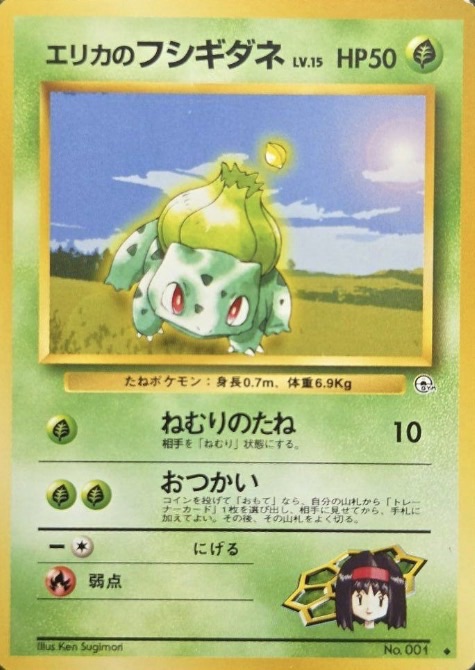
However, the Japanese promotional version is particularly interesting because it was printed with different artwork by Ken Sugimori and distributed through CoroCoro Comic.
Erika’s Bulbasaur Card Information
| Pokémon | Erika’s Bulbasaur |
|---|---|
| Japanese Name | エリカのフシギダネ |
| Pokédex Number | No. 001 |
| Level | Lv.15 |
| HP | 50 |
| Type | Grass |
| Stage | Basic Pokémon |
| Illustrator | Ken Sugimori |
| Japanese Expansion | Leaders’ Stadium |
| Promo Version | CoroCoro Comic December 1998 |
| Card Number | Unnumbered Promo |
The 1998 CoroCoro Comic Promo
The special Japanese promotional version was distributed through the December 1998 issue of CoroCoro Comic.
The magazine was released in Japan on November 15, 1998.
The card was included on a four-card insert together with three other Gym Pokémon:
- Erika’s Bulbasaur
- Misty’s Tentacool
- Lt. Surge’s Jolteon
- Brock’s Mankey
This is one of the classic ways Japanese Pokémon promos were distributed during the early era of the Pokémon TCG.
Rather than being sold as an individual card, the card was attached to a magazine product.
That distribution method also creates an interesting collecting challenge today.
A surviving copy can be found loose, but collectors can also encounter copies still attached to the original magazine insert.
The CoroCoro Version Has Different Artwork
This is one of the most important details about Erika’s Bulbasaur.
The regular Japanese Leaders’ Stadium version and the CoroCoro promotional version are not identical artworks.
Both were illustrated by Ken Sugimori, but the promotional print uses a different illustration.
This makes the CoroCoro card much more interesting for collectors who specialize in artwork variations.
It is not simply a normal Erika’s Bulbasaur with a different symbol or packaging.
It is a genuine alternate artwork from the same artist.
Regular Erika’s Bulbasaur vs. CoroCoro Promo
| Feature | Leaders’ Stadium | CoroCoro Promo |
|---|---|---|
| Release | October 1998 | November 1998 |
| Distribution | Expansion | CoroCoro Comic |
| Artwork | Ken Sugimori | Ken Sugimori |
| Artwork Variant | Regular | Different artwork |
| Card Number | 001 | Unnumbered Promo |
This distinction is extremely important when searching the market.
If you are specifically looking for the valuable CoroCoro version, simply searching for “Erika’s Bulbasaur Japanese” can bring up the much cheaper regular Leaders’ Stadium card.
Always check the artwork.
→ Search Erika’s Bulbasaur CoroCoro Promo on eBay
Affiliate Disclosure: As an eBay Partner Network affiliate, I may earn a commission from qualifying purchases at no additional cost to you.
Erika’s Bulbasaur and the English Gym Challenge Card
The English Pokémon TCG also received Erika’s Bulbasaur.
It was included in the English Gym Challenge expansion as card 39/132.
The English version uses the Gym Challenge artwork and is therefore different from the Japanese CoroCoro promotional artwork.
The English card retains the same basic concept of Erika’s Bulbasaur, with 50 HP and the attacks Sleep Seed and Errand-Running.
This creates an interesting collecting opportunity:
Japanese Leaders’ Stadium → Japanese CoroCoro Promo → English Gym Challenge
Three releases connected to the same Pokémon, but with different distribution histories and artwork considerations.
Sleep Seed
Erika’s Bulbasaur has the attack:
Sleep Seed — 10 damage
The defending Pokémon is then put to sleep.
It is a simple attack, but it fits the gentle, plant-themed identity of Bulbasaur and Erika’s Grass-type Gym.
Errand-Running
The second attack is one of the card’s most interesting features:
Errand-Running
Flip a coin. If heads, you may search your deck for a Trainer card, show it to your opponent, and put it into your hand before shuffling your deck.
For a vintage Basic Pokémon, searching for a Trainer card was a fun utility effect.
The coin flip also captures the gameplay design of the late 1990s Pokémon TCG, when many effects relied heavily on luck.
Why Is the CoroCoro Promo So Much More Valuable?
The regular Japanese Erika’s Bulbasaur is relatively inexpensive.
The CoroCoro promotional version is a completely different story.
Several factors contribute to the huge difference:
- It was distributed through a magazine rather than a normal expansion.
- It has exclusive artwork.
- It is an unnumbered Japanese promo.
- It is nearly three decades old.
- High-grade examples are difficult to find.
- Bulbasaur has enormous international collector demand.
- Erika is one of the most popular Gym Leaders from the original games.
But there is another factor that is especially important.
Condition.
The card was distributed as a magazine insert, which means copies could be exposed to bending, edge wear, surface scratches, and other damage before ever reaching a collector’s binder.
The Magazine Insert Problem
Collectors sometimes underestimate how important the original distribution method is.
A booster-pack card begins its life protected inside a sealed pack.
A magazine insert is different.
The card was physically attached to a magazine product and had to survive transportation, handling, storage, and eventually removal from the insert.
That creates a natural condition bottleneck.
Even if many copies were originally distributed, the number that survived in truly exceptional condition can be much smaller.
PSA Population
This is where the card becomes particularly interesting.
Current PSA data shows roughly 261 graded copies of the CoroCoro Glossy Erika’s Bulbasaur, with only 16 PSA 10 examples.
That means only a small percentage of graded copies have achieved Gem Mint 10 status.
PSA 9 examples are also considerably more common than PSA 10, but even a PSA 9 can command a substantial premium compared with raw copies.
Because the population is still relatively small, individual high-grade sales can have a significant effect on the perceived market price.
Erika’s Bulbasaur PSA 10 Price
The current market for the CoroCoro Glossy version is surprisingly strong.
Recent market guides place the approximate PSA 10 value around $9,750, although individual completed sales have varied significantly.
Recent PSA 10 transactions have included approximately:
| Grade | Approximate Current Market |
|---|---|
| Raw | ~$25–$50 |
| PSA 7 | ~$45–$100+ |
| PSA 8 | ~$200+ |
| PSA 9 | ~$1,700–$2,000 |
| PSA 10 | ~$4,000–$10,000+ |
For example, a PSA 10 example sold at Fanatics Collect in February 2026 for $4,080.
Other PSA 10 sales have reached approximately $6,000 and $13,500.
Because sales are relatively infrequent, these numbers should be viewed as a range rather than a guaranteed market price.
Active listings can also be much higher than completed sales.
Why Is the PSA 10 Premium So Extreme?
The current market provides an excellent example of condition rarity.
A raw copy can still be worth only a few dozen dollars.
But a copy that survives in exceptional condition can enter a completely different collector market.
With only a small number of PSA 10 examples, collectors competing for the highest grade can push prices dramatically higher.
This is especially true for Japanese vintage promos that combine:
- Character popularity
- Japanese exclusivity
- Unique artwork
- Magazine distribution
- Low Gem Mint population
- Strong international demand
What Makes Erika So Popular?
Erika is one of the original Gym Leaders from the Kanto region.
Her elegant character design and Grass-type specialization have made her one of the most collectible Gym Leaders from the original Pokémon era.
Her Pokémon cards include several highly desirable vintage releases.
Erika’s Bulbasaur is particularly appealing because it combines the character with one of the most popular first-generation Pokémon.
That gives the card two major collector audiences:
Erika collectors + Bulbasaur collectors.
And then there is the Ken Sugimori artwork.
Ken Sugimori Artwork
Ken Sugimori is one of the most important artists in Pokémon history.
His artwork helped define the visual identity of the original Pokémon games and the early Pokémon TCG.
The fact that the CoroCoro promotional Erika’s Bulbasaur uses artwork by Sugimori adds another layer of appeal.
For collectors building a Ken Sugimori artwork collection, this is a particularly interesting vintage promo.
How to Identify the CoroCoro Version
If you’re searching for this card, the easiest mistake to make is buying the ordinary Japanese Leaders’ Stadium version by accident.
Check the following:
- Compare the artwork carefully.
- Look for the CoroCoro promotional print.
- Confirm that the card is the unnumbered promotional version.
- Do not rely solely on the seller’s title.
- Compare the card image against known CoroCoro examples.
The artwork difference is the key.
A seller may simply write “Erika’s Bulbasaur Japanese” without realizing that there are multiple versions.
That is why image-based comparison is extremely important when buying an ungraded copy.
→ Check Erika’s Bulbasaur PSA Prices on eBay
Raw vs. Graded: Which Should You Buy?
For collectors who simply want to own the artwork, a raw copy can be a much more affordable way to enter the market.
For collectors who believe they have found an exceptional copy, grading can be tempting.
However, the difference between a PSA 8, PSA 9, and PSA 10 can be enormous.
Before submitting a raw copy, inspect:
- Front surface
- Back surface
- Corner sharpness
- Edge whitening
- Centering
- Print lines
- Indentations
- Scratches
Vintage Japanese cards can look beautiful at first glance while still having small defects that prevent a Gem Mint grade.
A Card Worth Adding to a Bulbasaur Collection
If your goal is to build a complete vintage Bulbasaur collection, this card deserves special attention.
It is not simply another copy of Bulbasaur.
It combines:
- Erika
- Bulbasaur
- Ken Sugimori
- Japanese vintage TCG
- CoroCoro Comic
- Exclusive artwork
- 1998 distribution history
That combination is difficult to reproduce in another card.
Final Thoughts
Erika’s Bulbasaur is one of those vintage Japanese Pokémon cards that looks relatively ordinary until you learn its story.
The regular Japanese Leaders’ Stadium version is easy to overlook.
But the CoroCoro Comic promotional version is a completely different collecting proposition.
It was distributed through a 1998 Japanese magazine, features alternate Ken Sugimori artwork, and has become surprisingly valuable in high grades.
With PSA 10 examples reaching several thousand dollars—and some sales going well into five figures—the card has become one of the more interesting vintage Japanese Bulbasaur investments for collectors.
And perhaps the most interesting part is how easy it is to miss.
If you see an Erika’s Bulbasaur in a Japanese vintage collection, check the artwork carefully.
You may be looking at a $10 card.
Or you may have found one of the rarest Bulbasaur promos from the 1990s.
→ Find Erika’s Bulbasaur CoroCoro Promo on eBay
Related Guides
- Japanese Gym Heroes / Leaders’ Stadium Guide
- Japanese Gym Series Card Guide
- Most Valuable Vintage Japanese Pokémon Cards
- Birthday Pikachu: Japanese Vintage Promo Guide
- Pokémon Card Fan Club Trainer Card Guide
Looking for more vintage Pokémon card guides?
Visit the complete archive here: