▶ Browse All Vintage Japanese Pokémon Card Guides
GR Team Lugia is one of the most unusual and desirable vintage Japanese Pokémon promotional cards from the original Pokémon TCG era.
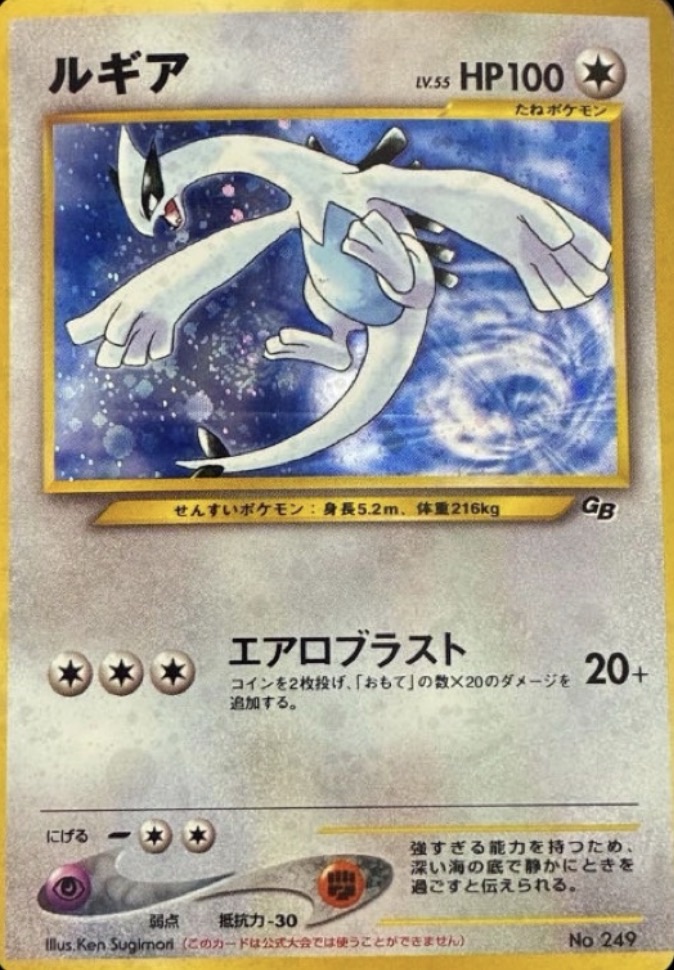
Unlike a normal expansion card, this Lugia was distributed with the Game Boy Color title Pokémon Card GB2: Here Comes Team GR! in Japan. It was packaged together with GR Team Mewtwo, making the two cards one of the most recognizable promotional pairs connected to the Pokémon Card GB games.
The card is especially interesting because it combines one of Pokémon’s most popular Legendary Pokémon with a unique video-game history, a Japanese-exclusive distribution, and the distinctive artwork of Ken Sugimori.
For international collectors, this card is often searched for as GB2 Lugia, Game Boy Lugia, GR Team Lugia, or Lugia #249 Japanese Promo.
With high-grade copies becoming increasingly expensive, this is a card that deserves much more attention from collectors of vintage Japanese Pokémon cards.
Why Is GR Team Lugia So Expensive?
The biggest reason is its unusual distribution history.
GR Team Lugia was not released in a regular booster pack. Instead, it was included with the Game Boy Color game Pokémon Card GB2: Here Comes Team GR!.
This immediately makes it different from most vintage Pokémon cards.
Collectors are not simply buying an old Lugia. They are buying a piece of the Pokémon Card GB2 era and one of the rare physical connections between the Pokémon Trading Card Game and the Game Boy Color games.
Lugia itself is another major factor.
As one of the most recognizable Legendary Pokémon from Generation II, Lugia has enormous collector demand around the world. When that popularity is combined with a Japanese-exclusive Game Boy promotion, the result is a card with significant international appeal.
The card also features a very distinctive vintage Lugia illustration that is completely different from many of the Lugia cards collectors know today.
Card Information
- Card: Lugia
- Japanese Name: ルギア
- Level: Lv.55
- HP: 100
- Type: Colorless
- Card Number: No. 249
- Series: Pokémon Card GB2 Promotional Card
- Release: 2001
- Distribution: Pokémon Card GB2: Here Comes Team GR!
- Language: Japanese
- Finish: Holo
- Illustrator: Ken Sugimori
- Special Mark: GB symbol
- Tournament Status: Not legal for official tournaments
The Pokémon Card GB2 Connection
Pokémon Card GB2: Here Comes Team GR! was the sequel to the original Pokémon Card GB.
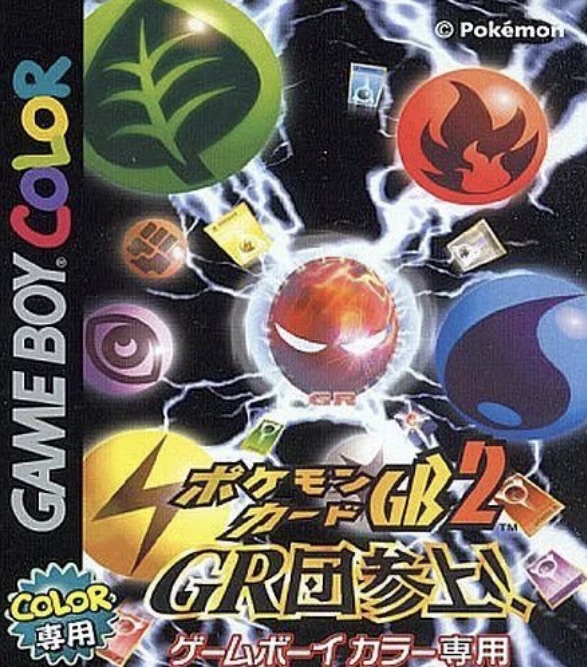
The game introduced the GR Team storyline and expanded the Pokémon Card Game concept within the Game Boy Color environment.
Unlike the first game, GB2 had its own original setting and characters, including the GR Team.
The physical Lugia promotional card was included with the game, alongside GR Team Mewtwo.
This is an important distinction when collecting the card.
The Lugia is not simply a regular Neo-era Lugia that happened to be included in a game. It was specifically produced as a promotional card connected to the GB2 release.
The card also carries the small GB symbol, making its connection to the video game immediately recognizable.
For collectors interested in Pokémon video game memorabilia as well as Pokémon cards, this creates an especially strong collecting theme.
Lugia and GR Team Mewtwo Were Distributed Together
One of the most interesting aspects of this promotion is that Lugia was distributed together with GR Team Mewtwo.
The two cards represent completely different sides of the Pokémon Card GB2 world.
Lugia is the legendary Pokémon associated with the second generation, while GR Team Mewtwo represents the original GR Team concept created for the game.
Because they were packaged together, collectors can build a particularly interesting two-card display:
Lugia
×
GR Team Mewtwo
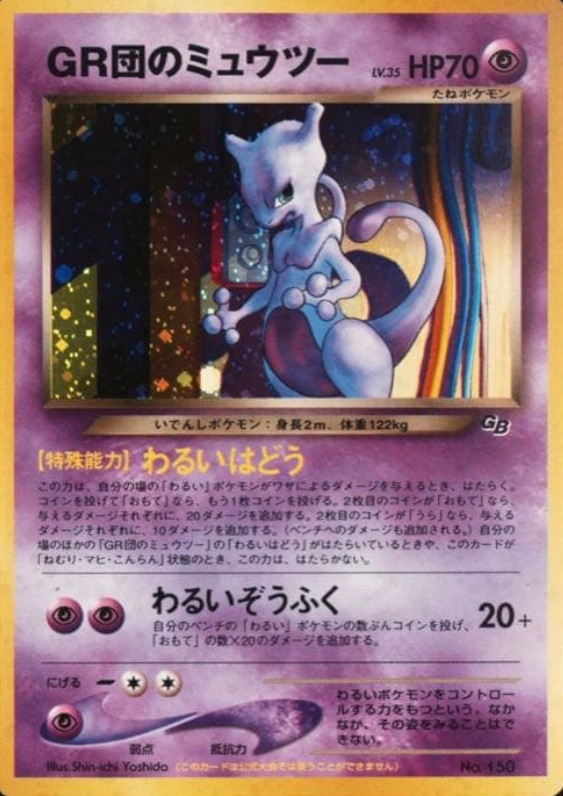
Unopened examples containing both cards are especially desirable because they preserve the original distribution format rather than simply preserving two individual cards.
A recent Japanese market example of an unopened Lugia and GR Team Mewtwo pair reached approximately ¥450,000, or around $2,813.
For advanced collectors, an unopened pair is therefore a completely different collecting category from simply owning the two cards individually.
The Artwork by Ken Sugimori
Another major attraction is the artwork.
The card features Lugia flying through a dramatic blue scene, with the legendary Pokémon surrounded by swirling energy and water.
The artwork is credited to Ken Sugimori, one of the most important artists in Pokémon history.
There is a very different feeling compared with many modern Lugia cards.
The illustration has the unmistakable aesthetic of early Japanese Pokémon artwork, making it particularly attractive to collectors who prefer the original era.
The combination of Sugimori artwork, the old card frame, holo treatment, and GB symbol gives the card a very strong vintage identity.
A Unique Lugia Outside the Regular Expansion Sets
One reason collectors sometimes overlook this card is that it does not fit neatly into the normal expansion-set collecting structure.
When people think about vintage Lugia, they often immediately think about Lugia ★ from Neo Genesis.
GR Team Lugia is a completely different collectible.
Its appeal comes from its promotional history rather than simply being a powerful or rare card from a standard expansion.
This is one of the reasons Game Boy promotional cards have become increasingly interesting to advanced collectors.
They document a period when Pokémon was expanding across different forms of media, and the trading card game was directly connected to the Game Boy games.
Price Guide
GR Team Lugia has experienced a significant increase in value, particularly in high grades.
| Condition | Approximate Market Value |
|---|---|
| Near Mint (NM) | ≈ $990 |
| Moderately Played (MP) | ≈ $700 |
| PSA 9 | ≈ $1,500–2,000 |
| PSA 10 | ≈ $3,500–7,000+ |
Recent market references show raw examples around the high hundreds of dollars, while PSA 9 copies can be found around the $900 range.
PSA 10 is where the market becomes much more aggressive.
Recent international transactions have reached several thousand dollars, with some PSA 10 sales exceeding $6,000 and individual auctions reaching approximately $8,100.
These numbers demonstrate how much the market separates high-grade copies from ordinary raw cards.
Prices are approximate and can change rapidly. Active asking prices should not be confused with completed sales, especially for rare vintage cards with relatively low transaction volume.
Affiliate Disclosure: As an eBay Partner Network affiliate, I may earn a commission from qualifying purchases at no additional cost to you.
Why Is the Lugia More Expensive Than GR Team Mewtwo?
This is one of the most interesting aspects of the GB2 promotional pair.
Lugia and GR Team Mewtwo were distributed together, yet their market values can be dramatically different.
The biggest reason is simply character demand.
Mewtwo is enormously popular, but Lugia has become one of the strongest collector characters from Generation II, particularly among vintage collectors.
The Lugia also benefits from the broader popularity of Lugia’s other vintage cards, including the famous Neo-era Lugia.
As collectors build complete Lugia collections, unusual promotional versions such as this one become increasingly important.
This creates a situation where two cards from the same promotion can have completely different market profiles.
Why Collectors Like GR Team Lugia
There are several reasons this card has become such a desirable vintage Japanese promo.
- Lugia is one of the most popular Legendary Pokémon.
- The card was distributed with Pokémon Card GB2 rather than a normal expansion.
- It is a Japanese-exclusive promotional release.
- The card features artwork by Ken Sugimori.
- The card carries the distinctive GB symbol.
- It was distributed together with GR Team Mewtwo.
- Unopened pairs are particularly desirable.
- High-grade copies command a significant premium.
Put together, these characteristics make GR Team Lugia much more than another old Lugia card.
eBay Market for GR Team Lugia
eBay is one of the most important marketplaces for international collectors searching for this card.
Because the card was released only in Japan, overseas collectors often have to rely on international marketplaces rather than local card stores.
Useful search terms include:
- GR Team Lugia
- GB2 Lugia
- Game Boy Lugia Japanese
- Lugia 249 Japanese Promo
- Lugia GB2 Promo
- Japanese Lugia Old Back
When searching eBay, it is important to look beyond the first page of results.
Some sellers describe the card simply as “Japanese Lugia Promo”, while others use terms such as “GB2,” “Game Boy,” “Old Back,” or “No. 249.”
Because Lugia has many different Japanese promotional and vintage versions, the card image and number should always be checked carefully.
Check Sold Prices Before Buying
For a card at this price level, checking completed sales is particularly important.
An active eBay listing asking $10,000 does not necessarily mean the market value is $10,000.
Completed auctions and accepted Best Offer transactions provide a much better indication of what collectors are actually paying.
This is especially important for PSA 10 copies because individual sales can vary considerably depending on timing, eye appeal, centering, holo pattern, and buyer demand.
Buying Tips for GR Team Lugia
Because there are many vintage Lugia cards, buying the correct version requires careful identification.
Before purchasing, check the following:
- Confirm that the card is Lugia.
- Confirm Lv.55 and HP100.
- Confirm the card number No. 249.
- Look for the GB symbol.
- Confirm the Japanese language.
- Check that the artwork matches the GB2 promotional Lugia.
- Confirm the Ken Sugimori attribution.
- Inspect the holo surface for scratches.
- Check the corners for whitening.
- Check the edges carefully.
- Inspect the back for whitening and surface damage.
- For graded copies, verify the grade and certification information.
Be especially careful when searching for Lugia #249.
The number 249 is also associated with other Lugia listings and databases, so the card artwork and GB2 characteristics should be checked rather than relying only on the number in a seller’s title.
Raw vs. PSA: Which Should You Buy?
The decision between a raw copy and a graded copy depends heavily on your collecting goals.
A raw copy can be attractive if you want to examine the card yourself or potentially submit it for grading.
However, the difference between a high-grade raw copy and a PSA 10 can be enormous.
For a vintage holo card that is already trading for hundreds of dollars in raw condition, buying a raw card solely because you hope it will become a PSA 10 involves considerable risk.
Surface scratches, whitening, centering, print defects, and other imperfections can prevent a card from receiving the highest grade.
If your primary goal is simply to own a high-grade GR Team Lugia, purchasing an already graded example may provide greater certainty.
If you enjoy the hunt and have experience evaluating vintage cards, raw copies can be much more interesting.
The Unopened GB2 Lugia & GR Team Mewtwo Pair
For advanced collectors, the ultimate version of this promotion may be the original unopened pair.
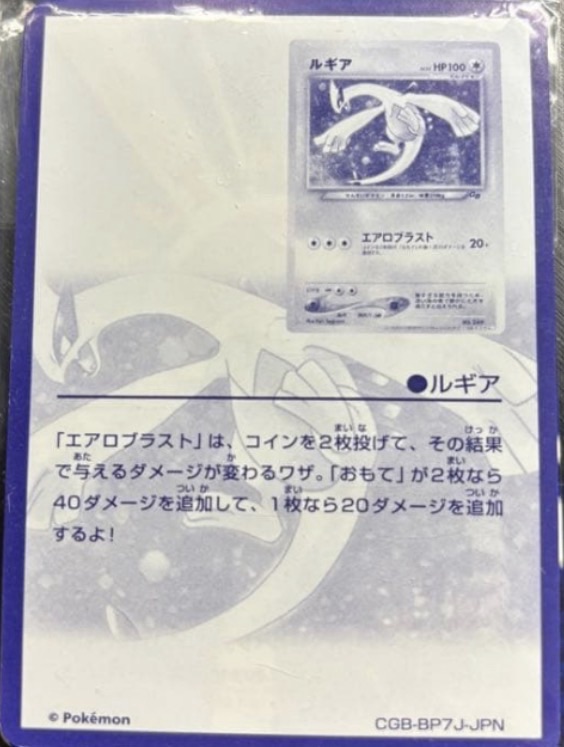
The unopened package preserves the way the cards were originally distributed with the Game Boy Color game.
Instead of simply displaying two individual cards, an unopened pair tells the story of the promotion itself.
That makes it particularly attractive to collectors of:
- Pokémon Card GB memorabilia
- Game Boy Color Pokémon items
- Japanese promotional cards
- Vintage sealed Pokémon products
- Lugia collections
- GR Team collections
It is also one of the clearest ways to understand the relationship between Lugia and GR Team Mewtwo.
GR Team Lugia as a Video Game Collectible
One of the most appealing aspects of this card is that it sits between two collecting worlds.
It is a Pokémon TCG card, but its origin is directly connected to a Game Boy Color video game.
This makes it particularly attractive to collectors who grew up with Pokémon games as well as Pokémon cards.
The GB symbol reinforces this connection.
For a collector building a complete Pokémon Card GB collection, GR Team Lugia is an essential card.
For a Lugia collector, it represents one of the more unusual vintage promotional versions.
For a Japanese promo collector, it is an example of an unusual distribution method that cannot be replicated today.
That crossover appeal is a major part of the card’s strength.
Is GR Team Lugia a Good Vintage Pokémon Card to Collect?
No collector can guarantee future price appreciation, but GR Team Lugia has many characteristics that make it a compelling long-term collectible.
- One of the franchise’s most popular Legendary Pokémon.
- Japanese-exclusive Game Boy promotional history.
- Distinctive vintage holo artwork.
- Ken Sugimori artwork.
- Connection to Pokémon Card GB2.
- Distributed with GR Team Mewtwo.
- Strong international collector demand.
- Limited high-grade population.
The strongest argument for owning the card is therefore not simply its price.
It represents a very specific moment in Pokémon history when the card game, video games, and original Japanese promotional campaigns were closely connected.
That historical context gives the card lasting collector appeal regardless of short-term market movements.
Frequently Asked Questions
How was GR Team Lugia distributed?
GR Team Lugia was included with the Japanese Game Boy Color title Pokémon Card GB2: Here Comes Team GR!.
What is the card number?
The card is identified as No. 249.
What Level is GR Team Lugia?
It is Lv.55 with 100 HP.
Who illustrated GR Team Lugia?
The artwork is credited to Ken Sugimori.
Does GR Team Lugia have a GB symbol?
Yes. The card carries a distinctive GB symbol that identifies its connection to the Pokémon Card GB games.
Was GR Team Lugia tournament legal?
No. The promotional card was not legal for official tournament play.
Did Lugia come with GR Team Mewtwo?
Yes. Lugia and GR Team Mewtwo were distributed together with Pokémon Card GB2. Unopened pairs are particularly desirable among collectors.
How much is GR Team Lugia worth?
Recent market references put raw Near Mint copies around the high hundreds of dollars, while PSA 10 examples can reach several thousand dollars. Recent PSA 10 transactions have exceeded $6,000, although individual prices vary significantly.
Is there an English version?
There is no equivalent English release of this Japanese GB2 promotional card. This Japanese-exclusive history is one of the reasons international collectors pursue it.
Why is the card so expensive?
The value comes from the combination of Lugia’s popularity, its Japanese-exclusive Game Boy distribution, vintage holo design, Ken Sugimori artwork, and strong demand from international collectors.
Related Guides
- GR Team Mewtwo Guide
- Shining Mew Guide
- WHF Pikachu Guide
- Vintage Japanese Pokémon Card Article Index
Looking for more vintage Pokémon card guides?
Visit the complete archive here: